

What rectal prolapse is
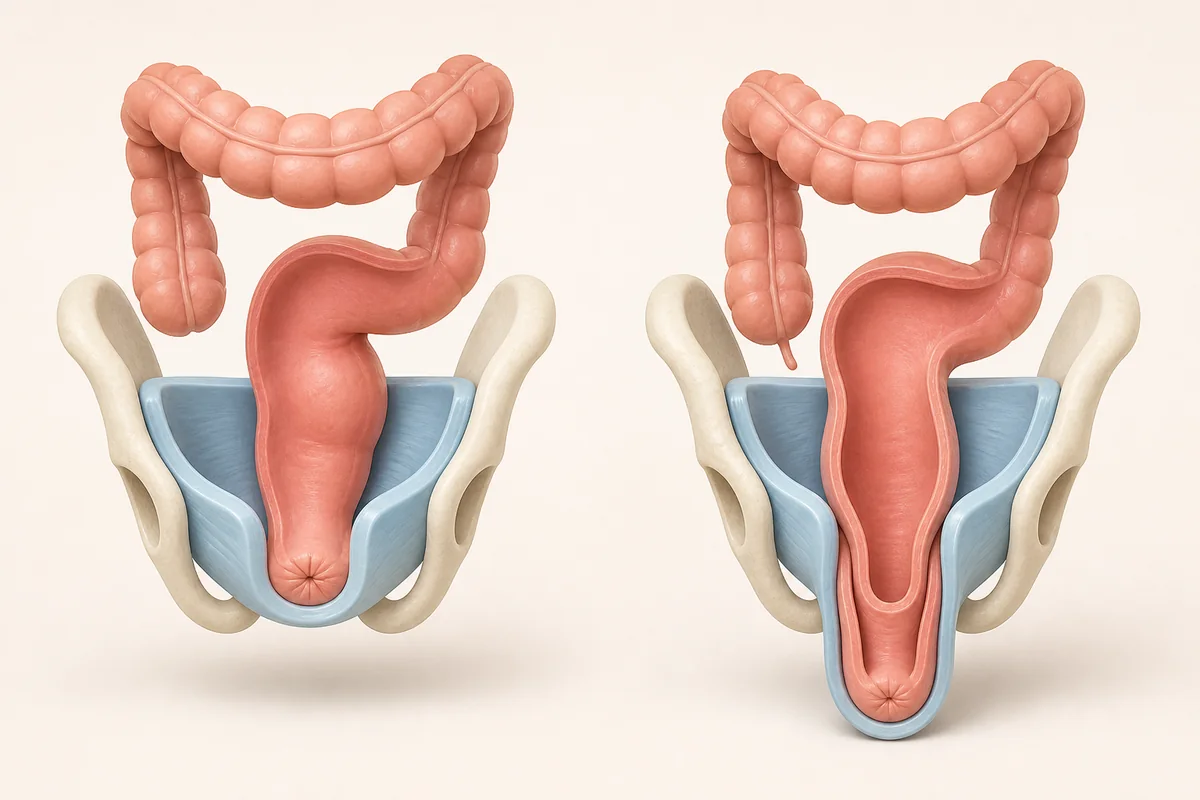
Rectal prolapse occurs when part or all of the rectal wall protrudes through the anus. Internal prolapse may remain inside. The condition is different from piles, although the appearance and symptoms can overlap.
Symptoms
Difference from piles
| Feature | Rectal prolapse | Piles |
|---|---|---|
| Tissue | Rectal wall protrudes | Haemorrhoidal cushions prolapse |
| Appearance | Often circular folds | May appear as separate lumps |
| Function | Can affect continence and emptying | Bleeding or prolapse more typical |
| Assessment | May need bowel and pelvic-floor evaluation | Anoscopy and grade assessment may be used |
Diagnosis
Assessment may include examination at rest and with straining, bowel-habit review, continence questions and tests such as colonoscopy, defaecography, transit studies or pelvic-floor assessment in selected patients.
Non-surgical management
Fibre, fluids, stool consistency, avoiding prolonged straining, pelvic-floor therapy and skin care may help symptoms. These measures do not necessarily correct a full-thickness prolapse but can improve preparation and recovery.
When surgery may be considered
Surgery may be discussed when prolapse is persistent, difficult to reduce, causes incontinence, bleeding or ulceration, or significantly affects quality of life. Frailty, constipation, continence and previous operations influence the approach.
Abdominal and perineal approaches
| Approach | General concept | Selection considerations |
|---|---|---|
| Abdominal | Rectum is mobilised and fixed, sometimes with bowel resection | Fitness, constipation, anatomy and previous surgery |
| Perineal | Prolapsed bowel is treated through the anus or perineum | May be considered for selected older or higher-risk patients |
| Laparoscopic | Abdominal operation through small incisions | Requires suitability and verified expertise |
Rectopexy
Rectopexy fixes the rectum to reduce prolapse. Variations include suture, mesh and resection approaches. The specific operation, material and evidence should be described only after service verification.
Recovery
Bowel-function expectations
Prolapse correction may improve some symptoms but can also leave or change constipation and incontinence. Pre-operative testing and a realistic discussion of functional goals are important.
Risks
Potential benefits
- Correction of visible prolapse
- Potential improvement in seepage or obstruction symptoms
- Reduced irritation or bleeding
Risks and limitations
- Recurrence
- Constipation or altered bowel function
- Bleeding, infection or injury
- Mesh-related risks where mesh is used
- Anaesthesia and blood-clot risks
Frequently asked questions
No. They can both cause a protruding lump, but rectal prolapse involves the rectal wall and needs a different assessment.
Bowel-habit and pelvic-floor measures may reduce symptoms or straining, but full-thickness prolapse often needs a surgical discussion.
Choice depends on prolapse type, bowel function, health, previous surgery and surgeon expertise.
Constipation or incontinence may improve, persist or change. Expectations should be discussed before treatment.